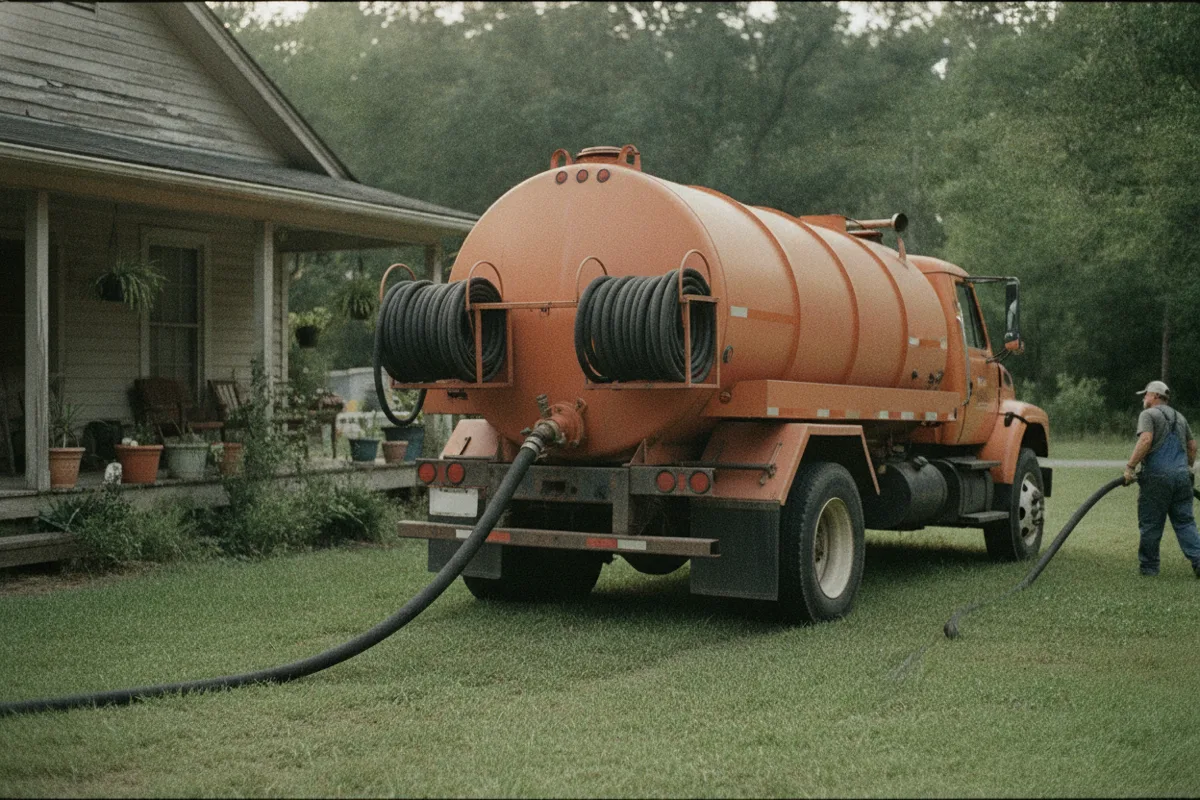
What actually happens during a septic tank pump out?

A real pump out is more than backing a truck up and dropping a hose in the hole. Here is the order of work on a normal residential job.
First the tech finds and uncovers the lids. Most tanks around here have two, one over the inlet side and one over the outlet. If they are buried under eight inches of sod, that adds time to the visit.
Next comes measurement. Before anything moves, a probe tells us how deep the bottom sludge and the top scum crust have gotten. That number is what decides whether you are on a good schedule or running late.
Then the tank comes down to the floor. The vacuum hose pulls the liquid first, then the operator back flushes some of it to break up the packed sludge and pulls that out too. A tank left with a foot of solids in the bottom was not pumped, it was skimmed.
If yours has been skimmed for years, what it needs is a full sludge removal visit instead.
With the tank empty, the inlet and outlet baffles are visible for the first time in years, so they get checked. A missing outlet baffle is the fastest way to send solids straight into your drain field.
Last, the lids go back on, the ground gets tidied, and you hear what the septic tank pump out cost covered and when to expect the next visit.
How do you know your septic tank is full?

Septic systems give plenty of warning before they quit. The trick is knowing what to watch for.
Call for service if you see slow drains in more than one fixture, gurgling toilets, standing water or a stripe of unusually dark green grass over the tank or field, or a sewage smell in the yard. One slow sink is a clog. Three slow fixtures at once is a system problem.
Backups show up at the lowest drain in the house first, which in most Wiregrass homes is a tub or a laundry room floor drain. If sewage is already on the floor, stop running water and call before it spreads any further.
Two signs people miss: a toilet that flushes fine at 6 a.m. and sluggishly at 6 p.m., and a control panel beeping on a system with a pump tank. Both say the tank is holding more than it should.
How often to pump a septic tank in this part of Alabama

Plan on pumping every 3 to 5 years for a typical family home. Federal guidance puts the average household in the same window and recommends a professional look at the system every three years. You can read it yourself at EPA.gov/septic.
Tank size drives a lot of the schedule. Most three and four bedroom homes in Coffee and Dale County sit on a 1,000 to 1,500 gallon concrete tank, sized when the system was first permitted.
A 1,000 gallon tank serving five people fills far faster than the same tank serving two.
Habits matter as much as size. A garbage disposal roughly doubles the solids going in. Heavy laundry days, long showers, and a water softener discharging to the tank all shorten the interval.
Rental turnover is a real factor near Fort Novosel. A landlord in Enterprise and the surrounding county who pumps between tenants never inherits somebody else's neglect, and it is a cheap job to do while the house sits empty.
How much does it cost for septic tank pumping? Enterprise AL ranges

Nobody can quote your driveway sight unseen, but here is what is normal in southeast Alabama. A standard residential pump out usually runs about $250 to $500, with larger or badly overdue tanks landing higher.
Four things move that number:
- Tank size. A 1,500 gallon tank holds half again as much waste to haul and dispose of as a 1,000 gallon tank.
- Access. If the truck parks within 100 feet of the lid, it is a normal job. Pulling 200 feet of hose around a fence line is not.
- Distance. A house ten minutes off Highway 167 costs less to reach than one at the end of a dirt road. Fuel and drive time are real costs.
- Condition. A tank untouched for twelve years needs extra water and extra time to break the sludge loose.
Digging up a buried lid adds to the bill every single visit, which is why installing risers to grade pays for itself in about two services. Ask about it while the truck is already there.
Homes out toward the New Brockton side of the county often share a route with their neighbors, so booking two or three houses the same morning can hold everyone's cost down.
What should you expect on service day?

Plan on 45 to 90 minutes for a normal pump out. You do not have to be home if we know where the lid is and the gate is unlocked, though most people like to be there.
Before the truck arrives, move vehicles off the path to the tank, put dogs inside, and mark the lid if you know where it sits.
A vacuum truck is heavy, and soft ground after a Wiregrass thunderstorm is worth a five minute conversation before anyone drives across the yard.
You should get three things at the end: an honest description of what the tank looked like, a note on anything worth watching, and a date for the next service.
Keep that record. It answers questions later at closing time, when a buyer's agent asks for proof of maintenance.
If the tech spots a cracked lid, a failed baffle, or water standing at the outlet, you will hear about it while the tank is open and easy to reach. That is the cheapest moment to fix any of it.
What pumping will not fix
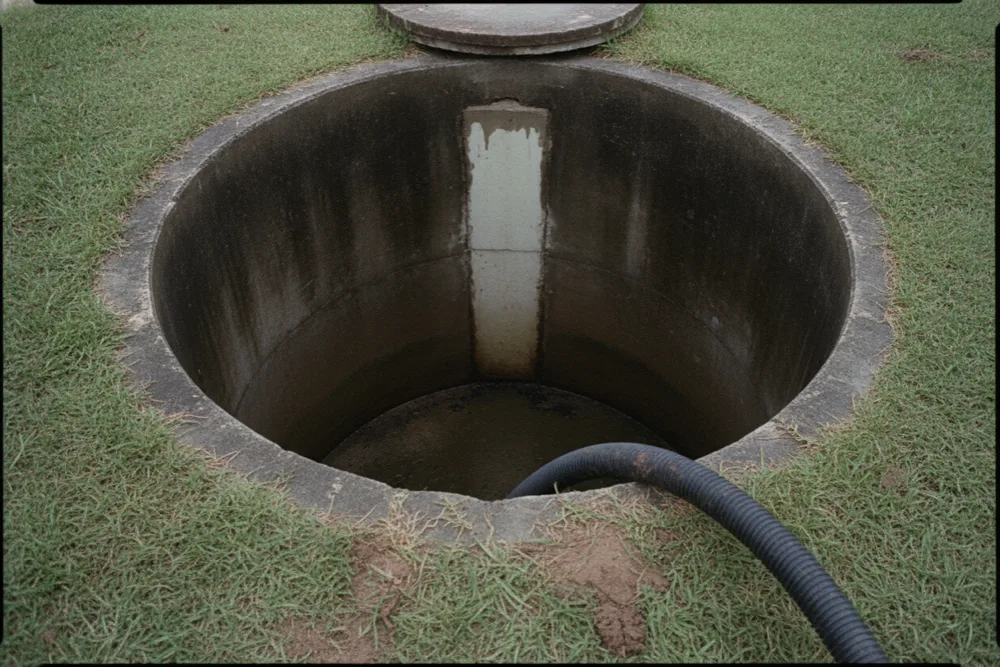
Pumping empties the tank. It does not repair the part of the system that returns water to the ground.
If your drain field is saturated, an empty tank buys you a few days of normal flushing and then you are right back where you started. That pattern, where a house needs sewage tank pumping every few months, almost always points to a field that has stopped absorbing.
Repairs and replacements are not a do it yourself weekend, either. On site sewage systems in Alabama are permitted and regulated by the state health department, and changing one generally needs approval first.
Rules and county contacts are posted at the Alabama Department of Public Health onsite sewage program.
The good news is that most systems in Coffee County fail for boring, preventable reasons. Stay on schedule, keep wipes and grease out, keep traffic off the field, and a well built system runs for decades.